Workflow automation for functional medicine: save 4+ hours daily
Discover how workflow automation saves functional medicine practitioners 4+ hours daily while improving patient care through AI-powered protocols and personalized nutrition plans.

Functional medicine practitioners face a daily challenge: balancing complex patient protocols with mounting administrative work. Workflow automation saves clinicians over 4 hours daily by handling data intake, care plan generation, and longitudinal tracking. This guide explores how AI-powered automation tailored to specialized protocols like Bredesen, Shoemaker, and Wahls transforms practice efficiency while improving patient outcomes.
Table of Contents
- Introduction To Workflow Automation In Functional Medicine
- How Advanced Automation Technologies Work
- Impact Of Workflow Automation On Patient Care And Efficiency
- Common Misconceptions About Clinical Automation
- Comparison Of Workflow Automation Solutions For Functional Medicine
- Implementing Workflow Automation In Your Practice
- Explore Meelio's AI-Powered Workflow Automation Solutions
- Frequently Asked Questions
Key takeaways
| Point | Details |
|---|---|
| Core automation components | Data intake, AI decision support, and personalized care plans streamline complex functional medicine workflows. |
| Specialized AI advantage | Protocol-specific platforms outperform generic AI scribes in accuracy, integration, and clinical outcomes for integrative health. |
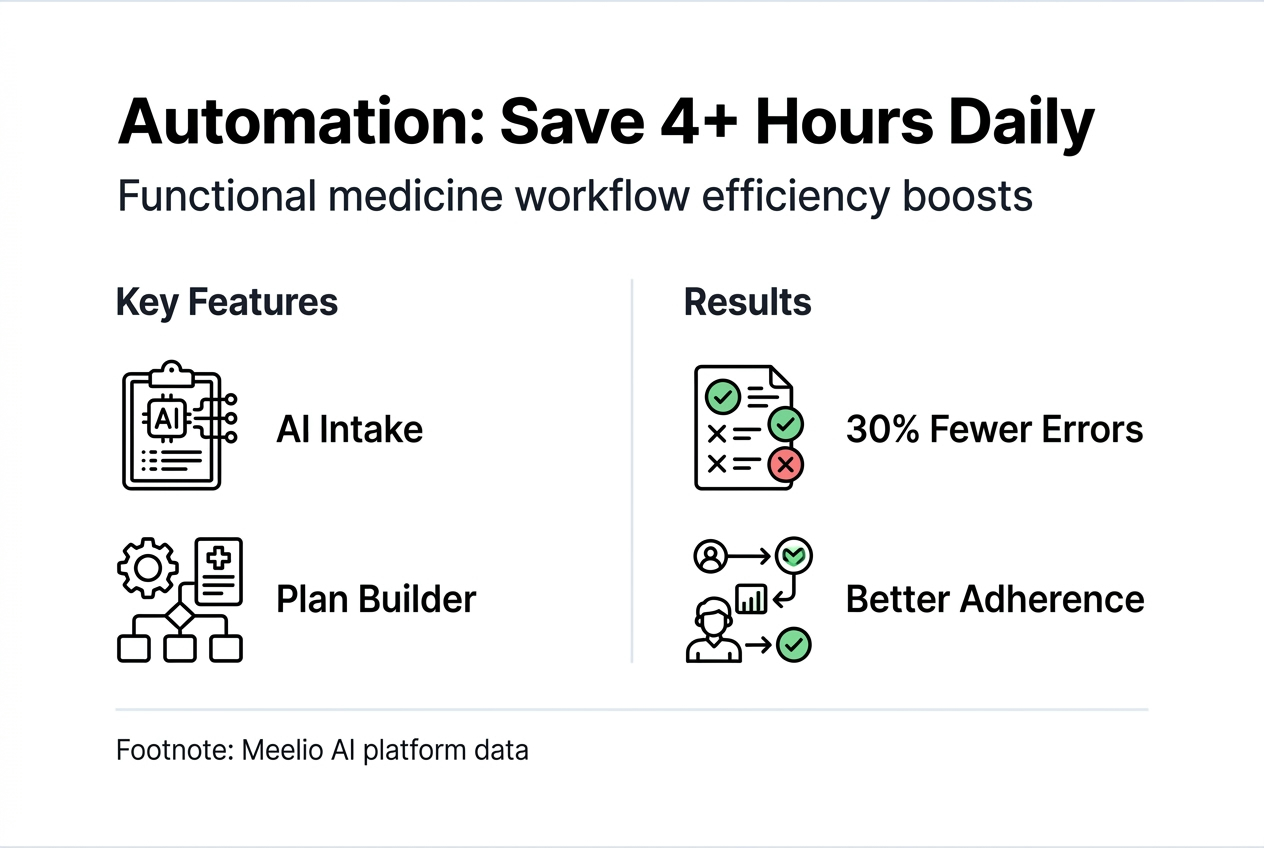
| Measurable practice impact | Automation delivers 4+ hour daily time savings, 30% fewer documentation errors, and 30% better patient adherence. |
| Clinician augmentation | Automation supports clinical judgment rather than replacing it, freeing practitioners for meaningful patient interactions. |
| Implementation success factors | Choose specialized platforms, ensure EHR integration, train staff thoroughly, and monitor outcomes continuously. |
Introduction to workflow automation in functional medicine
Workflow automation in functional medicine represents an AI-powered modular system customized for integrative health protocols. Unlike generic office automation, clinical workflow automation addresses the unique complexity of personalized nutrition planning, multi-system chronic illness management, and protocol-driven care.
The core components work together seamlessly:
- Patient data intake: Automated collection and organization of health history, lab results, and symptom questionnaires
- Clinical decision support: AI-powered analysis applying specific protocols to patient data for diagnostic and treatment insights
- Personalized care plan generation: Automated creation of nutrition recommendations, supplement protocols, and lifestyle modifications tailored to individual patient needs
- Outcome and adherence tracking: Continuous monitoring of patient progress, lab trends, and protocol compliance
These components directly tackle the challenges functional medicine practitioners face daily. Complex protocols like Bredesen's ReCODE require synthesizing dozens of biomarkers, while Shoemaker's biotoxin illness protocol demands meticulous environmental and lab tracking. Manual data work consumes hours that could be spent on patient education and relationship building.
For dietitians integrating functional approaches, automation transforms how they develop meal plans aligned with elimination diets, blood sugar management, or autoimmune protocols. Rather than spending 45 minutes manually creating a Wahls Protocol meal plan, automation generates personalized options in minutes while ensuring nutritional adequacy.
The efficient patient management workflow these systems create allows practitioners to see more patients without sacrificing care quality. This scalability proves essential for growing integrative practices competing in a healthcare landscape increasingly focused on efficiency metrics.
How advanced automation technologies work
AI and machine learning form the technological backbone of clinical workflow automation, but not all AI operates equally. Specialized AI engines trained on functional medicine protocols understand the nuanced relationships between biomarkers, symptoms, and interventions that generic tools miss.
These platforms work through several sophisticated processes:
- Protocol application: AI trained on Bredesen, Shoemaker, or Wahls frameworks interprets patient data through those specific lenses, identifying relevant patterns and generating protocol-aligned recommendations
- Personalization algorithms: Machine learning models consider individual patient factors like genetics, lifestyle constraints, food preferences, and previous responses to customize interventions
- Longitudinal analysis: Automated tracking compares current labs against historical trends, flagging meaningful changes that inform protocol adjustments
- Natural language processing: AI extracts clinical insights from patient notes and questionnaires, reducing manual data entry
Protocol-specific AI improves care plan personalization and patient outcomes by 30% compared to generic approaches. This advantage stems from the AI's deep understanding of each protocol's logic and priorities.
Consider this comparison:
| Feature | Specialized AI Platforms | Generic AI Scribes |
|---|---|---|
| Clinical focus | Protocol-specific care plans, nutrition recommendations, lab analysis | Transcription and note summarization |
| Integration depth | Seamless EHR data flow with Practice Better, Cerbo | Limited clinical system integration |
| Personalization | Individual protocol customization based on patient complexity | Generic templates with minimal adaptation |
| Decision support | Evidence-based recommendations aligned with Bredesen, Shoemaker, Wahls | Basic symptom documentation |
| Outcome tracking | Automated longitudinal analysis and trend detection | Manual review required |
| Time savings | 4+ hours daily across workflow | 1-2 hours on documentation only |
Pro Tip: Choosing AI platforms aligned with your clinical protocols ensures higher accuracy and better patient engagement. Generic tools force you to manually translate outputs into protocol-specific language, eliminating much of the efficiency gain.
The technical sophistication of specialized platforms extends to meal planning automation. When generating a 7-day anti-inflammatory meal plan for a patient with multiple food sensitivities, the AI simultaneously considers nutritional targets, elimination requirements, preparation complexity based on patient lifestyle, and variety to prevent monotony. This multi-dimensional optimization exceeds what practitioners can achieve manually in reasonable timeframes.
Integration with existing healthcare automation workflows ensures these technologies enhance rather than disrupt established practice patterns. Data flows bidirectionally between the automation platform and your EHR, eliminating duplicate entry while maintaining a single source of truth for patient information.
Impact of workflow automation on patient care and efficiency
The measurable benefits of workflow automation extend far beyond simple time savings, though those alone justify adoption. Functional medicine practices implementing specialized automation platforms report transformative improvements across multiple dimensions.
Time efficiency gains prove immediately apparent:
- Documentation reduction: Automated note generation and care plan creation saves over 4 hours daily, time previously spent on manual charting and protocol documentation
- Meal planning acceleration: What once required 45 minutes per patient now takes 5 minutes with AI-generated personalized nutrition plans
- Lab analysis streamlining: Longitudinal tracking automatically flags significant trends, eliminating hours of manual chart review
- Administrative task automation: Intake forms, questionnaires, and data organization happen in the background without staff intervention
Quality improvements accompany these efficiency gains. Automation reduces documentation errors by 30% by eliminating transcription mistakes and ensuring protocol compliance. When AI cross-references supplement recommendations against patient medications and known interactions, it catches potential issues human review might miss during busy clinical days.

Patient outcomes show measurable enhancement. Practices report 30% improvement in patient adherence to complex protocols when automation delivers personalized meal plans with shopping lists and preparation guidance. This adherence improvement directly correlates with better clinical outcomes, as patients actually implement recommendations rather than feeling overwhelmed by generic advice.
Critical Impact: Automation saves clinicians 4+ hours daily while reducing errors by 30% and improving patient adherence by 30%, creating a triple benefit for practice sustainability and patient outcomes.
Perhaps most significantly, automation frees practitioners to focus on what drew them to functional medicine: meaningful patient relationships and clinical problem-solving. Rather than spending consultation time documenting or explaining basic protocol logistics, clinicians engage in therapeutic education, motivational interviewing, and addressing patient concerns. This shift elevates job satisfaction while improving the patient experience.
The compounding effect of these improvements transforms practice economics. Seeing two additional patients daily without extending work hours generates substantial revenue increases while reducing clinician burnout risk. Practices scale sustainably rather than sacrificing quality for growth.
Common misconceptions about clinical automation
Despite compelling benefits, misconceptions about workflow automation persist and prevent some practitioners from exploring these tools. Addressing these myths head-on clarifies realistic expectations and proper implementation approaches.
Myth: Automation replaces human clinical judgment
Reality: Specialized automation augments clinical decision-making by handling data synthesis and protocol application, but practitioners maintain full control over final recommendations. The AI presents evidence-based options aligned with chosen protocols; clinicians apply their expertise, patient knowledge, and clinical intuition to customize and approve plans. This partnership leverages both computational power and human wisdom.
Myth: Automation diminishes patient engagement quality
Reality: By eliminating administrative burden, automation actually enhances patient interactions. Practitioners arrive at consultations with AI-generated preliminary care plans, allowing them to spend the entire session discussing patient concerns, barriers to implementation, and motivation rather than data collection. Patients receive more personalized attention, not less.
Myth: Generic AI tools suffice for complex clinical workflows
Reality: Tools designed for general medical transcription lack the protocol-specific intelligence functional medicine requires. A generic AI might document that a patient needs "dietary changes," while a specialized platform generates a complete Wahls Protocol Level 2 meal plan with specific micronutrient targets and approved food lists. The depth difference directly impacts clinical utility and patient outcomes.
Myth: Automation implementation always disrupts workflows
Reality: When properly integrated with existing EHRs and matched to practice patterns, automation feels invisible to both practitioners and patients. The technology works in the background, surfacing insights and recommendations at natural decision points rather than creating additional steps or system-switching friction.
Pro Tip: Successful adoption depends on viewing automation as a clinical assistant, not a replacement. Frame it internally as gaining a highly trained team member who handles time-consuming tasks with perfect accuracy, freeing you for higher-value clinical work.
Managing expectations proves crucial. Automation excels at pattern recognition, protocol application, and personalization within defined frameworks. It does not replace the need for clinical expertise in complex cases, patient relationship building, or adapting protocols to unique circumstances. Understanding this balance prevents disappointment and optimizes technology utilization.
The practitioners who gain maximum value treat automation in healthcare clinical workflows as collaborative intelligence. They leverage AI-generated insights as starting points for clinical reasoning rather than endpoints, combining computational efficiency with professional judgment.
Comparison of workflow automation solutions for functional medicine
Choosing the right automation platform significantly impacts implementation success and long-term value realization. Functional medicine practitioners need solutions that understand their specific protocols rather than forcing adaptation to generic medical workflows.
Key selection criteria include:
- Protocol specificity: Does the platform natively support Bredesen, Shoemaker, Wahls, or other frameworks you use regularly?
- EHR integration compatibility: Seamless data flow with Practice Better, Cerbo, or your existing systems eliminates duplicate entry
- AI sophistication level: Protocol-specific intelligence versus generic transcription or basic automation
- Personalization depth: Individual customization based on patient complexity and preferences
- User interface design: Intuitive workflows that match clinical thought processes
- Vendor support quality: Training resources, technical assistance, and ongoing platform development
- Scalability: Ability to grow with your practice without performance degradation
| Criteria | Specialized Clinical Platforms | Generic AI Scribes |
|---|---|---|
| Protocol support | Native Bredesen, Shoemaker, Wahls frameworks with evidence-based recommendations | No protocol awareness; practitioners manually apply frameworks |
| Care plan generation | Automated, personalized plans including nutrition, supplements, lifestyle with rationale | Summarizes practitioner dictation without generating recommendations |
| Meal planning | AI-created protocol-specific meal plans with recipes and shopping lists | Not available; practitioners create manually |
| Lab analysis | Longitudinal tracking with automated trend detection and protocol-relevant flagging | Basic transcription of lab values without interpretation |
| EHR integration | Bidirectional data flow with Practice Better, Cerbo for seamless workflows | Limited integration requiring manual data transfer |
| Error reduction | 30% fewer documentation errors through automated protocol compliance checks | Transcription accuracy only; no clinical validation |
| Time savings | 4+ hours daily across full clinical workflow | 1-2 hours on documentation tasks only |
| Patient engagement tools | Automated personalized resources and education materials | Not included |
Platforms like Meelio AI demonstrate the specialized approach advantage. By training AI specifically on functional medicine protocols, these tools generate clinically accurate care plans that practitioners can implement with minimal modification. The automation saves hours while boosting care quality because the AI understands protocol nuances.
Contrast this with generic AI scribes that excel at transcription but lack clinical intelligence. These tools help with documentation speed but do not reduce the cognitive load of synthesizing patient data, applying protocols, or creating personalized nutrition plans. Practitioners still perform all clinical reasoning manually.
For practices focused on specific populations, consider specialized features. Dietitians working primarily with autoimmune conditions benefit from platforms offering extensive elimination diet support and reintroduction tracking. Practitioners emphasizing cognitive decline need robust Bredesen protocol implementation with detailed supplement protocol generation.
Integration depth with your existing patient management workflow determines daily friction levels. Platforms requiring manual data export/import between systems negate much of their efficiency benefit. Seamless integration means the automation platform becomes an invisible extension of your EHR, surfacing insights within your normal workflow.
Decision factors extend beyond feature lists to practical implementation considerations. Vendor responsiveness matters when technical issues arise. Comprehensive training resources accelerate staff adoption. Regular platform updates ensure you benefit from AI improvements and expanding protocol support.
Implementing workflow automation in your practice
Successful automation adoption follows a structured approach that addresses technical, workflow, and human factors. Rushing implementation without proper planning often leads to underutilization and disappointment.
Step 1: Assess workflow bottlenecks
Document where time disappears in your current processes. Track how long you spend on intake data review, care plan creation, meal planning, lab analysis, and documentation for a typical patient. Identify repetitive tasks that follow consistent patterns. These represent prime automation targets.
Step 2: Choose automation platforms specialized for your protocols
Match platform capabilities to your clinical focus areas. If 80% of patients follow Wahls Protocol, prioritize platforms with deep Wahls support rather than broad but shallow coverage. Request demonstrations using your actual patient scenarios to evaluate real-world fit. Verify EHR integration compatibility before committing.
Step 3: Integrate with existing EHR and practice systems
Work closely with platform technical support during integration setup. Map data fields between systems to ensure accurate information flow. Test the integration thoroughly with sample patients before going live. Address any data synchronization issues early to prevent frustration during clinical use.
Step 4: Train clinicians and staff thoroughly
Invest time in comprehensive training covering both technical operation and clinical application philosophy. Help team members understand how automation augments rather than replaces their expertise. Create internal champions who can troubleshoot common issues and encourage adoption. Schedule follow-up training sessions to address questions after initial real-world use.
Step 5: Monitor outcomes and refine workflows
Track key metrics including time savings, documentation accuracy, patient adherence rates, and clinical outcomes. Gather staff feedback on workflow friction points. Adjust processes based on real usage patterns rather than theoretical workflows. Continuously optimize how you leverage automation capabilities as you discover new applications.
Pro Tip: Engage technical support early for smooth integration and invest in ongoing staff education. Most implementation challenges stem from insufficient training rather than platform limitations.
Common failure points include unrealistic expectations, inadequate training, and resistance to workflow changes. Address these proactively through transparent communication about what automation can and cannot do. Involve staff in platform selection to build buy-in. Start with high-impact, low-complexity use cases to build confidence before tackling more sophisticated applications.
Change management proves as important as technical implementation. Some team members may feel threatened by automation, fearing job displacement. Frame the technology as enabling everyone to work at the top of their license, handling more complex and satisfying tasks while automation manages routine work. Celebrate early wins to build momentum.
The transition period typically spans 4-8 weeks as practitioners develop comfort with new workflows. Initial productivity may dip slightly as teams learn the system, but this quickly reverses as automation benefits compound. Patience during this adjustment phase prevents premature abandonment of valuable tools.
Integrating automation in healthcare clinical workflows sustainably requires viewing it as an ongoing practice evolution rather than a one-time technology purchase. Regular platform updates bring new capabilities. Your clinical needs evolve. Maintain flexibility to adapt your automation utilization as both technology and practice mature.
Explore Meelio's AI-powered workflow automation solutions
Transform your functional medicine practice with Meelio's specialized automation platform designed specifically for integrative health practitioners. Our AI assistant goes beyond generic transcription to deliver protocol-specific clinical intelligence tailored to complex frameworks like Bredesen, Shoemaker, and Wahls.
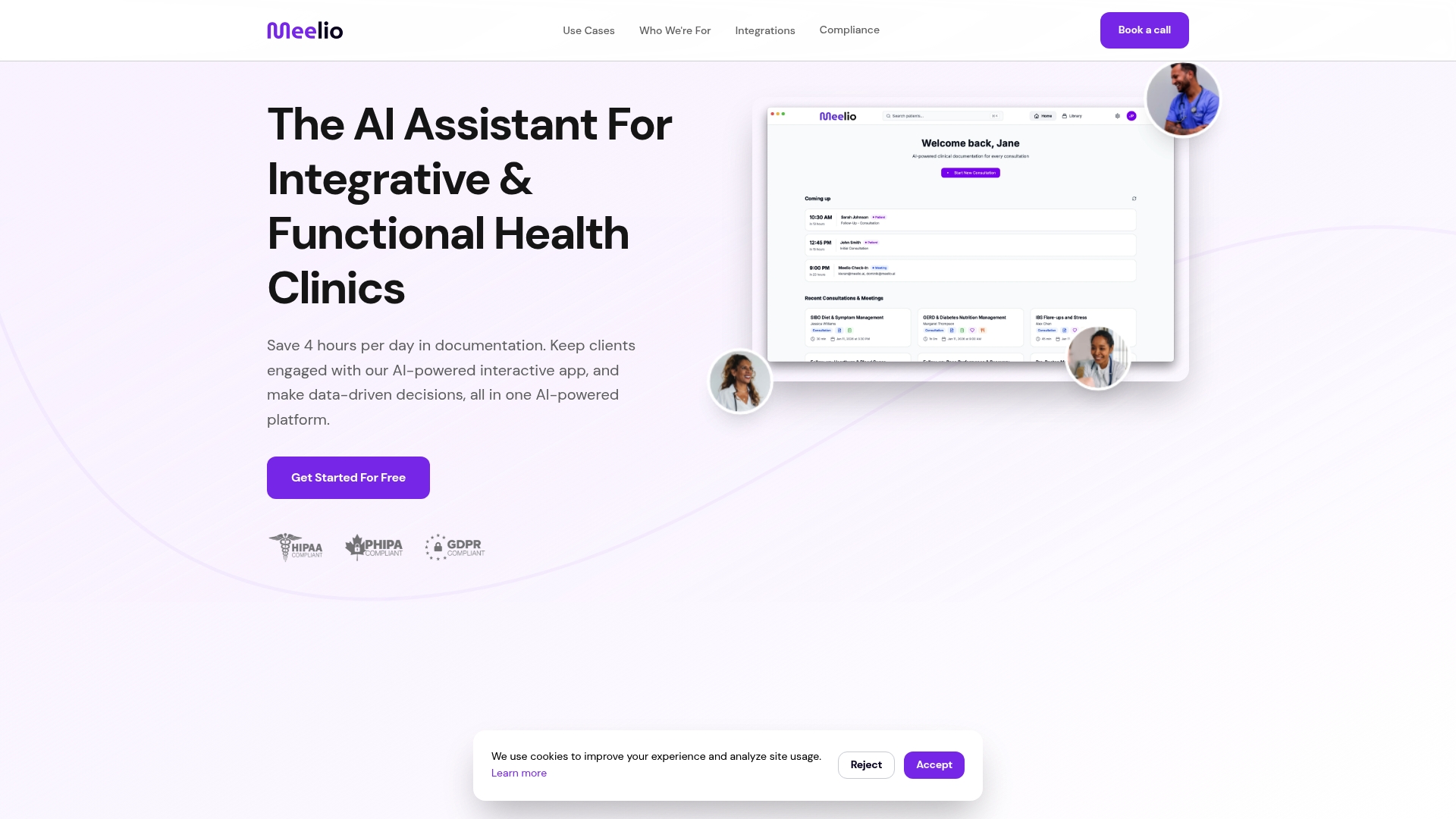
Meelio offers comprehensive solutions that address your complete clinical workflow. Our AI care plans generate personalized treatment protocols in minutes, while our AI meal planning creates nutrition recommendations aligned with your chosen therapeutic approach. Seamless integration with Practice Better and Cerbo ensures your existing systems work together effortlessly.
Key benefits include saving 4+ hours daily on administrative tasks, improving care plan personalization through protocol-specific AI, and enhancing patient outcomes with better adherence tools. Explore how Meelio's platform can streamline your practice while elevating the care you deliver. Our comprehensive training resources ensure smooth onboarding and maximum return on your technology investment.
Frequently asked questions
What is workflow automation in functional medicine?
Workflow automation represents AI-driven processes that streamline clinical tasks from initial patient data intake through personalized care plan creation and ongoing outcome tracking. Unlike generic office automation, functional medicine workflow automation specifically supports complex protocols like Bredesen's ReCODE, Shoemaker's biotoxin illness treatment, or the Wahls Protocol by applying protocol-specific logic to patient data. The technology handles time-consuming tasks like synthesizing lab results, generating nutrition recommendations, creating meal plans, and tracking longitudinal health trends while practitioners maintain clinical oversight and final decision authority.
How does workflow automation improve patient care?
Automation enhances care quality by reducing documentation errors by 30%, personalizing protocols to individual patient needs, and enabling timely adjustments based on automated trend detection. By handling routine tasks, automation frees clinicians to spend consultation time on therapeutic education, motivational interviewing, and addressing patient barriers to protocol implementation. This increased face-to-face engagement improves patient understanding and adherence, leading to measurably better clinical outcomes and higher patient satisfaction scores.
What are common challenges when adopting workflow automation?
Integration with existing EHR systems often presents technical challenges requiring careful planning and vendor support to ensure seamless data flow. Staff training and change management prove crucial, as team members need both technical skills and conceptual understanding of how automation augments their clinical roles. The biggest pitfall involves expecting automation to replace clinical judgment rather than viewing it as a collaborative tool that handles data synthesis while practitioners apply expertise and patient knowledge to final recommendations.
How long does it take to implement workflow automation?
Typical implementation spans 4-8 weeks from initial platform setup through staff achieving comfortable proficiency. The technical integration with your EHR usually completes within 1-2 weeks, while training and workflow adjustment continue over the following month. Practices may experience a brief initial productivity dip as teams learn new systems, but this quickly reverses as automation benefits compound. Full optimization often takes 3-6 months as you discover advanced capabilities and refine processes based on real-world usage patterns.